
For Best Results Take CoQ10 with PQQ
There is a bounty of research on CoQ10 in regards to cardiovascular disorders, cancer, diabetes, periodontal disease…
And my favorite - free radicals. That is a molecule 'out of balance' as it needs to gain or lose an electron.
Why is that my favorite?
Well -- this type of chemistry is a building block of electronics, a field I have been fascinated with for a long time. A fundamental chemical activity essential to electronic devices. You know silicon, copper, gold and the like. But this chemistry is not so good for human tissue.
This is what I mean:
A free radical will oxidize our cells when it gains or loses an electron. This oxidation is damaging. A CoQ10 molecule will accept or donate an electron without becoming a free radical.
CoQ10 can reduce damaging oxidation of our cells by reducing free radicals. This is significant as the root of many diseases is thought to be due to excessive stress from the oxidation of free radicals.
This is great news but absorbing CoQ10 as we get older is not so easy to do. That's why Dr. Al Sears uses ubiquinol, a super-absorbent form of CoQ10. This he combined with PQQ which keeps the CoQ10 in your blood stream longer.
Introducing Dr Al Sears Primal Force Ultra-Accel.
Ultra Accel list of Ingredients

RubyNewBee

CoQ10 is Dead
By Dr Al Sears
My patients are surprised when I tell them that I now think Coenzyme Q10 is obsolete.
If they’ve read my letters they know that it’s been one of my most favorite supplements.
When I first recommended CoQ10 it was very unpopular. I had other doctors take my patients’ CoQ10 and throw it in the garbage.
But now, I no longer recommend CoQ10.
There are a couple of reasons.
First, it’s very difficult to absorb CoQ10 as you get older. Plus, you need a new form of CoQ10 that’s more powerful than the old form.
And, CoQ10 can only get you so far...
You’re still going to have decreased energy as you age no matter how much CoQ10 you take because you’re not producing enough of the cellular “batteries” that give you energy anymore.
And that’s why I’m writing to you today.
You see, I’m using a breakthrough discovery that regenerates and recharges your cellular energy.
This amazing molecule provides the “spark” that ramps up energy production throughout your body — by growing NEW “batteries” in every cell — and giving you the drive, vitality, and stamina you enjoyed in your youth.
And I’m NOT talking about CoQ10.
This discovery is completely NEW, and I’m one of the only doctors using this nutrient to help my patients, and readers like YOU.
Now you can enjoy renewed vitality, increased energy, and a whole new life … just by taking a natural nutrient that I take every day of my life.
Let me show you how this works.
Re-energize Your “Cellular Batteries”
The culprits behind your fatigue and tiredness are trillions of tiny little generators in your cells you can’t even see—as incredible as that sounds!
Here’s the story: Every one of the cells in your body has hundreds of tiny biological batteries in them – called mitochondria. They generate all the energy you need to live, work, and play.
As you age, however, your mitochondria wither, and all your youthful power drains away. The ability of your cells to generate energy declines. This leaves you more fatigued, with less vigor and stamina, than you had when you were younger.
Recently, the Annals of the New York Academy of Science published a surprising new study confirming the depletion of mitochondria with age. It revealed that in the muscle tissue of a 90-year-old man, 95% of the mitochondria were damaged.
As a result, this man’s cells were generating as little as 1/20th of the energy they did when he was young. No wonder the older we get, the more tired we feel!
But today I’m excited to share an incredible medical breakthrough with you….
A New Nutrient That Both Feeds And Grows Mitochondria As Easy As Putting Grass Seed And Fertilizer On Your Lawn
It’s the breakthrough discovery of a little-known bioactive compound called pyrroloquinoline quinone – PQQ for short. It triggers your DNA to replace old mitochondria which have lost their ability to generate energy.
What’s truly astonishing is that PQQ stimulates mitochondrial biogenesis … the growth of NEW mitochondria … so that the total number of “batteries” producing energy in your cells actually increases.
In one laboratory experiment, mice fed PQQ for 8 weeks increased their mitochondria by 55% vs. a control group of mice that were not given PQQ.
You can think of growing new mitochondria with PQQ as replacing an old, under-powered AAA battery with a bank of fresh, high-voltage power cells.
Your energy will multiply exponentially — and your body will crackle with new intensity and vitality. You’ll experience newfound physical power and a surge of energy you haven’t felt in years.
I know this just from my own experience… and what my patients who take my new PQQ formula, Ultra Accel, are telling me.
But there is also a significant body of clinical research that proves PQQ’s ability to grow new mitochondria and enhance the mitochondrial functions that generate cellular energy:
- According to a University of California study, PQQ is up to 5,000 times more efficient in sustaining mitochondrial energy production than other common antioxidant compounds such as vitamin C.
- A study reported in the Journal of Biological Chemistry found that PQQ triggers the growth of new mitochondria within human cells. This can contribute to increased longevity, improved energy utilization, and protection from reactive oxygen species.
- An animal study found that when young mice are deprived of dietary PQQ, they have fewer mitochondria in their tissues, stunted growth, and a low survival rate. Mice with a PQQ deficiency had a 20% to 30% reduction in the relative amount of mitochondria in their liver.
In addition to stimulating the growth of new mitochondria, PQQ improves the function of the mitochondria you already have. Let me explain….
Turn More Of Your Food Into Cellular Energy!
On a cellular level, mitochondria perform respiration. They convert glucose, from the food you eat -- and oxygen, from the air you breathe -- into carbon dioxide, water, and energy.
This “cellular respiration” is the biological process responsible for energy production in your body. Clinical studies prove that it is enhanced by PQQ.
Researchers in one study found that low PQQ levels in test subjects depressed mitochondrial function. When these participants were given a PQQ boost, their mitochondrial function improved.
Other studies show improvements in metabolism and physical endurance in patients with mitochondrial diseases who take PQQ. The PQQ seems to restore the mitochondrial energy production that the patients’ illnesses suppressed.
Some of the things that can harm mitochondria are dangerous free radicals. They are capable of destroying healthy cells through unchecked oxidation. A study published in the Journal of Cardiovascular Pharmacology and Therapeutics concluded that PQQ is effective at protecting the mitochondria from oxidative damage.
As vital as PQQ is to protecting mitochondria, your body cannot make it. You have to consume it either in your food or supplements. Foods containing PQQ include tofu, green tea, green peppers, kiwi fruit, parsley, and eggs.
But you aren’t likely to get enough PQQ from eating. That’s why I recommend a supplement of 10 mg of PQQ daily to my patients. You can get this in my new energy-boosting supplement Ultra Accel.
Grow Back All The Energy-Producing Mitochondria
Age Has Taken Away
When I started taking Ultra Accel, I quickly felt the difference – a significant increase in my energy and vigor. And after studying the medical literature, I know that I’ve been given this incredible energy boost from both the repair of my existing mitochondria … as well as generating trillions of new mitochondria.
Since mitochondria are like cellular “batteries,” the more working batteries your cells have, the more energy they produce for your body to run on.
This is one of the reasons why young kids are so much more energetic than seniors.
Children have their full complement of mitochondria in every cell. Their cellular batteries have not been degraded by aging. Their bodies have plenty of energy to draw on for physical activities like running, playing, and sports.
But as the study I cited shows, when we age as many as 95% of our mitochondria break down. This means we are running on only 5% of the cellular batteries we were born with. As a result, we get more fatigued and feel more run down.
By repairing existing mitochondria and growing new ones, PQQ can give your body more cellular batteries than you had when you were a child, restoring your energy to more youthful levels – an important anti-aging effect.
In one clinical study, reported in Functional Foods in Health and Disease, 17 adults were given 20 mg of PQQ daily for 8 weeks. Sleep and appetite improved significantly, while fatigue, anxiety, and depression decreased.
But there’s even more good news about PQQ. The mitochondria-boosting properties of PQQ do more than just give you greater physical energy. Clinical research has also shown PQQ to improve brain function as well.
In a Chinese study, aging rats were given PQQ injections. The PQQ was shown to slow down the aging process of the neurons.
As an anti-aging specialist, to me this is one of the most thrilling aspects of PQQ: By measurably improving brain function, PQQ may help patients suffering from the onset of cognitive decline.
In another experiment, lab rats were subjected to oxidative stress for 48 hours. This can cause memory deficit. One group was given PQQ with CoQ10, while a control group received neither nutrient. The amazing result: those rats taking PQQ with CoQ10 had markedly improved memory when compared with the control group.
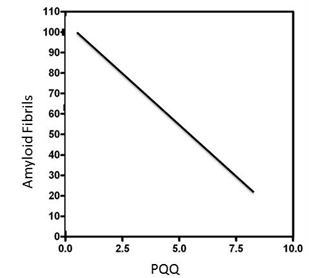
When amyloid fibrils form in the brain, they can damage the neurons. In a study published in Molecular Neurodegeneration, researchers found that increasing PQQ levels reduced the formation of amyloid fibrils (see graph below) – and therefore might be a possible treatment for Parkinson’s disease.
 |
There is even evidence that PQQ may help support normal heart health. One animal study found that PQQ acts as a free radical scavenger and is highly effective at improving cardiac function.
Give Your Cellular Batteries a Jump-Start
As I’ve shown you, mitochondria produce energy by converting glucose and oxygen into carbon dioxide, water, and energy. This is respiration on a cellular level.
The faster that respiration reaction takes place, the more energy your mitochondria can pump out. And in fact there is an enzyme that speeds this vital reaction and therefore increases cellular energy production. It’s one you’re likely familiar with: coenzyme Q10.
The benefits of high levels of coenzyme Q10 – increased energy, improved metabolism, lower blood pressure, and reduced risk of cardiovascular illness and cancer – are considerable and well-documented in medical literature.
Also well-documented is that your body’s CoQ10 levels decline as you age, which is why for years I have been telling all my adult patients to supplement with CoQ10 daily.
When you combine PQQ with CoQ10, it’s like turbo-charging your cell’s engine.
The PQQ grows more mitochondria and increases their function. The CoQ10 “jump starts” these cellular batteries, enabling them to produce even more power. It’s a winning 1-2 combination for multiplying your physical and mental performance.
To multiply the energy boost you get with Ultra Accel, in addition to the to the 10 mg of PQQ, I added a 50 mg dose of a super-absorbable form of CoQ10 known as ubiquinol.
I was the first physician to bring this breakthrough form of CoQ10 to America.
The renowned Japanese doctor and world's leading CoQ10 researcher, Dr. Tatsumasa Mae, personally consulted with me to help introduce this innovative form of CoQ10 that makes it so much more powerful.
With ubiquinol, your body absorbs up to 8 times more CoQ10 than with ordinary CoQ10 supplements. Better absorption means you can get more CoQ10 in your system while actually taking fewer pills.
Ultra Accel combines PQQ with pure ubiquinol – CoQ10 in its reduced form. As a result, the beneficial CoQ10 enzyme … remains in your blood stream much longer than with ordinary CoQ10 tablets.
This new and improved formula, Ultra Accel, is like CoQ10 on steroids. It combines the mitochondria-building power of PQQ with the energy accelerating effect of CoQ10.
The result: a bigger energy boost than either PQQ or CoQ10 can deliver alone.
But the CoQ10 in Ultra Accel can do more than just trigger increased energy production in your mitochondria. It can also protect the mitochondria you already have from aging. According to an article in the journal Biofactors, CoQ10 is a powerful antioxidant. Which means it can eliminate the free radicals that can damage mitochondria.
“CoQ10 On Steroids”
I know that ubiquinol is many times more effective at boosting energy than conventional CoQ10. That’s because it is so many times more absorbable.
Countless conversations with hundreds of my patients who take ubiquinol confirm its superior energy-boosting abilities.
Several years ago, I was fortunate enough to witness first-hand proof of ubiquinol’s superior performance in a unique experiment few other doctors have ever witnessed.
It took place in a private meeting I had with Dr. Tatsumasa Mae -- the world’s leading CoQ10 researcher --here at my Florida medical offices.
Dr. Mae showed me a fascinating video of the test subjects he used in an animal study of the anti-aging properties of CoQ10.
In the study, he divided the lab mice into three groups. Group one took no CoQ10. Group two took ordinary CoQ10. Group three mice took my super-absorbable ubiquinol.
The video showed that after several months, the Group One lab mice, those taking no CoQ10, all died of natural causes. All of the untreated mice showed typical signs of oxidative stress, suffering brain and heart damage.
Group two test mice took conventional CoQ10. They were still alive, but showed signs of aging. These mice lasted longer than the first group, but when they died, they had similar conditions.
But the third group of lab mice in the video had been given ubiquinol, my “super-absorbable” CoQ10. These test subjects actually looked younger than the mice in group two.
The group three mice also had more energy. They were running around in their cages with all the vigor of mice half their age. And in spite of being “old” (for mice), they showed almost no sign of aging.
After a year, the group three mice on ubiquinol aged 22% slower than the group two mice taking conventional CoQ10. In addition, the mice taking ubiquinol were able to run continuously on their treadmills two and a half times longer than mice taking conventional CoQ10.
I am tempted to call CoQ10 a “universal nutrient,” because it provides so many health benefits in addition to boosting energy. For instance, a group of adults with early macular degeneration who supplemented with CoQ10 for a year reported improvement in their vision.
A number of clinical studies have found improved mortality rates in cardiovascular patients taking CoQ10. Research also shows that taking CoQ10 helps control blood pressure.
Like PQQ, CoQ10 may also aid in cognition. An animal study performed at Johns Hopkins University found that CoQ10 supplementation improves learning and memory.
Other health benefits of taking CoQ10 include:
- Respiration. Researchers have found a correlation between low CoQ10 levels and the propensity to suffer from bronchial asthma.
- Migraine headaches. In one study, more than 6 out of 10 migraine sufferers who took CoQ10 daily reported a 55% reduction in the frequency of headaches.
- Gum disease. A study published in Molecular Aspects of Medicine reports that topical application of CoQ10 can improve the gum health of people suffering from periodontal disease as well as speed tissue healing following oral surgery.
- Skin care. A German study showed that CoQ10 can help reduce the appearance of wrinkles and protect skin from the damaging effects of too much exposure to sunlight.
- Blood sugar. An Australian study found CoQ10 helped diabetics control blood sugar levels.
My “Triple Play” For Cellular Energy Production
The first step in creating my new Ultra Accel was giving you 10 mg daily of high-quality PQQ, which created more, bigger, and better mitochondria for cellular power production.
The second step was to accelerate cellular energy production by adding 50 mg of ubiquinol, which your body can absorb up to 8X better than ordinary CoQ10.
But instead of stopping there, I found one more energy booster…
I added it to Ultra Accel, creating a triple energy play: 10 mg of tocotrienols – powerful antioxidants that are components of vitamin E.
More than a century ago, a science fiction writer published a novel in which animals fed a scientifically formulated “super food” grew to gigantic proportions.
Scientists tried a similar experiment by feeding catfish a diet including palm fatty acid distillate (PFAD), which is rich in tocotrienols.
To their amazement, the growth of the catfish on PFAD was significantly greater than a control group of catfish fed fish oil.
More important, a paper published in Toxicology reports that tocotrienols can protect mitochondria from oxidative damage caused by dangerous free radicals. This prevents the mitochondria from withering away as we age.
Aside from loss of energy and strength, we can also lose bone density as we age, making us more fragile. In an animal study, lab rats fed tocotrienols for 8 weeks reduced body fat mass while increasing bone calcium content.
Ultra Accel: My Secret Weapon For Anti-Aging
May I share a secret with you? I’m 57 and when I look at a lot of the men who are around my age, I shudder. Why? Because these guys look and act old. They’re ready for a rocking chair and a glass of lemonade on the porch.
One of the most common complaints I get from my patients is, “Dr. Sears, I’m sick and tired of feeling sick and tired!” Well, I don’t feel sick and tired.
I’m convinced one reason is that I take Ultra Accel every day. Ever since I started, I’ve felt more energetic, more vibrant, and more alive than ever.
PQQ is one nutrient I plan to take every day for as long as I live. You should, too. And now, by adding CoQ10 and tocotrienols, we’ve made taking Ultra Accel even more energizing and effective than ever.
When your shipment of Ultra Accel arrives, open a bottle and take one softgel. Do that every single day. Then, in a couple of weeks, look in a mirror and take a quick self-assessment.
I bet you’ll notice some subtle – and maybe not so subtle – changes. Most obviously, you’ll have more energy. You may feel better – less fatigued. And your blood pressure may improve.
But whatever the results, you are the final judge. If for any reason … or for no reason at all … you do not want to continue taking Ultra Accel, just return the unused portion – or even the empty bottles – at any time.
I’ll cheerfully give you a full and prompt refund of every penny paid, without question. That way, you risk nothing.
So what are you waiting for?
To take my Ultra Accel risk-free … and enjoy the energy-boosting benefits of my “CoQ10 on steroids” …Click Below
You have absolutely nothing to lose - and many years, even decades, of healthy living to gain.
To Your Good Health,

Al Sears, MD
Click HERE to view Primal Force Products catalog.
Click HERE to view Pure Radiance Products catalog.
Here to view Dr Al Sears, MD Wellness Center
Ultra-Accel list of Ingredients
References:
Bianconi et.al., Ann Hum Biol. 2013 Jul 5
Greco, et. al., The Journal of the Federation of American Societies for Experimental Biology, September 2003, vol. 17, no. 12, pp. 1706-1708: Marked aging-related decline in efficiency of oxidative phosphorylation in human skin fibroblasts
Linnane A, Kovalenko S, Gingold E. "The universality of bioenergetic disease: age-associated cellular bioenergetic degradation and amelioration therapy." Ann N Y Acad Sci. 1998;854:202-3
Chowanadisai W, et al. Full text: Pyrroloquinoline quinone stimulates mitochondrial biogenesis through cAMP response element-binding protein phosphorylation and increased PGC-1 alpha expression. J Biol Chem. 2010 Jan 1;285:142-52.
Dighe et. al., CoQ10: A Wonder Enzyme, Der Pharma Chemica 2010, 2(1): 236-250 Folkers, K. Biochemical and Biophysical Research Communications, 1988, 153(2):888-896 3B.
Bo-Qing Zhu, Comparison of PQQ on Mitochondrial Damage in a Rat Model of Ischemia/Reperfusion Injury, Journal of Cardiovascular Pharmacology and Therapeutics, June 2006, vol. 11, no. 2, 119-128 Stites T, Storms D, Bauerly K, et al. Full text: Pyrroloquinoline quinone modulates mitochondrial quantity and function in mice. J Nutr. 2006 Feb;136(2):390-6.
Isaac Asimov, Photosynthesis, Basic Books, 1968, pp. 54-55; Science News, July 31, 2007: A New Brake On Cellular Energy Production Discovered.
Nakano et. al., Functional Foods in Health and Disease, August 2012, vol. 2, no. 8, pp. 307-324: Effects of Oral Supplementation with Pyrroloquinoline Quinone on Stress, Fatigue, and Sleep.
Basic & Clinical Medicin (China), 2006-09 Effect of PQQ on the hippocampal neurons of aging rat induced by D-galactose
Journal of Clinical Biochemistry and Nutrition, January 2008, vol. 42, no. 1, pp. 29-34: Pyrroloquinoline Quinone (PQQ) Revents Cognitive Deficit Caused by Oxidative Stress in Rats
J. Kim et. al., The Inhibitory Effects of PQQ on the Amyloid Formation and Cytotoxicity of Truncated Alpha-Synuclein, Molecular Neurodegeneration, 2010 5:20
Cardiovascular Drugs and Therapy, November 2004, vol. 18, issue 6, pp. 421-431: Pyrroloquinoline Quinone (PQQ) decreases Myocardial /Infarct Size and Improves Cardiac Function in Rat Models of Ischemia and Ischemia/Rperfusion
Hoppe U, et. al. "Coenzyme Q10, a cutaneous antioxidant and energizer." Biofactors. 1999;9(2-4):371-8.
Singh R, Wander G, Rastogi A, Shukla P, Mittal A, Sharma J, Mehrotra S, Kapoor R, Chopra R. "Randomized, double-blind placebo- controlled trial of coenzyme Q10 in patients ..." Cardiovasc Drugs Ther. 1998;12(4):347-53.
Hodgson JM, Watts GF, Playford DA, Burke V, Croft KD. "Coenzyme Q10 improves blood pressure and glycemic control in a controlled trial in subjects..." Eur J Clin Nutr. 2002; 56(11):1137-42.
Qu J, Kaufman Y, Washington I. "Coenzyme Q10 in the human retina." Invest Ophthalmol Vis Sci. 2009;50(4):1814-8.
Schilling G, Coonfield M, Ross C, Borchelt D. "Coenzyme Q10 and remacemide hydrochloride ameliorate motor deficits in a … transgenic mouse model." Neurosci Lett. 2001;315(3):149-53
Gazdík F, Gvozdjáková A, Nádvorníková R, Repická L, Jahnová E, Kucharská J, Piják MR, Gazdíková K. "Decreased levels of coenzyme Q(10) in patients with bronchial asthma." Allergy. 2002 Sep;57(9):811-4.
Open Label Trial of CoQ10 as a Migraine Preventive, Cephalalgia April 2002 vol. 22 issue 2 pp.137-131 Hanioka T, Tanaka M, Ojima M, Shizukuishi S, Folkers K. "Effect of topical application of coenzyme Q10 on adult periodontitis." Mol Aspects Med. 1994;15 Suppl:s241-8
Blasi MA, Bovina C, Carella G, Genova ML, Jansen AM, Lenaz G, Brancato R. "Does coenzyme Q10 play a role in opposing oxidative stress in patients ...?" Ophthalmologica. 2001;215(1):51-4
Hodgson JM, Watts GF, Playford DA, Burke V, Croft KD. "Coenzyme Q10 improves blood ... and glycemic control in a controlled trial in subjects..." Eur J Clin Nutr. 2002;56(11):1137-42.
Ng et. al., Aquaculture, April 2004, vol. 233, issues 1-4, pp. 423-437: Replacement of dietary fish oil with palm fatty acid distillate elevates tocopherol and tocotrienol concentrations and increases oxidative stability in the muscle of African catfish, Clarias gariepinus
Toxicology, November 2000, vol. 155, issues 1-3, pp. 73-82: Oxidative damage to mitochondria in normal and cancer tissues, and its modulation by J.P. Kamat, T.P.A. Devasagayam
Ima-Nirwana, Journal of Medicinal Food, April 2004, vol. 7, no. 1, pp. 45-51: Effects of Tocopherols and Tocotrienols on Body Composition and Bone Calcium Content in Adrenalectomized Rats Replaced with Dexamethasone
management-issues.com/news/3899/fatigue-hits-us-productivity/ Management-issues.com 15 January, 2007: Fatigue hits U.S. productivity
|
* These statements have not been evaluated by the Food and Drug Administration. |
Click HERE to view catalog.
This Article is Provided by Dr Al Sears, MD